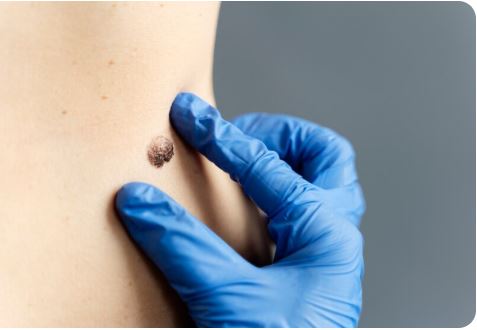
That Changing Mole May Be Worth a Closer Look
You notice that a mole looks slightly different from how you remember it. Maybe it has become darker, changed shape, started bleeding, or simply refuses to heal.
Your first thought may be, “It is probably nothing.”
It might be. Many skin changes are harmless. But a new or changing skin lesion should not be diagnosed by guesswork, especially if the change persists.
If skin cancer is suspected or confirmed, an experienced Onco Surgeon can help determine whether surgical removal is appropriate and what the treatment should involve.
What Does Skin Cancer Treatment Involve?
Skin cancer treatment depends on the type of cancer, its size, location, depth, and whether it has spread.
For many skin cancers, surgery is an important treatment because the abnormal tissue can be removed along with an appropriate margin of surrounding tissue.
But treatment is not identical for every lesion.
The first step is establishing exactly what the skin lesion is.
Not Every Mole Is Cancer
This is worth saying clearly.
A mole, skin tag, wart, or unusual-looking spot does not automatically mean cancer.
However, changes such as growth, bleeding, irregular borders, unusual colour, or a sore that does not heal can warrant medical evaluation.
Skin Changes You Should Get Checked
Consider seeing a doctor if you notice:
-
A mole changing in size or shape
-
A lesion becoming darker or developing multiple colours
-
An irregular border
-
A sore that does not heal
-
Repeated bleeding from a skin lesion
-
A new growth that continues to enlarge
-
A spot that looks noticeably different from your other moles
-
Persistent crusting or ulceration
These signs are not a diagnosis. They are reasons to stop guessing and get an appropriate assessment.
Diagnosis Comes Before Treatment
A specialist may examine the lesion and recommend further evaluation.
Depending on the appearance and clinical findings, this may involve dermoscopic examination, biopsy, pathology, or other investigations.
A biopsy can help determine whether cancer is present and identify the type of skin cancer.
Why Pathology Matters
Different skin cancers behave differently.
The pathology report helps the medical team understand what they are dealing with and can influence the surgical approach and whether additional treatment or follow-up is needed.
That is why removing a suspicious lesion without understanding the diagnosis and appropriate surgical margins is not something patients should attempt to plan themselves.
Surgery Can Be Highly Individualised
For some skin cancers, surgical removal may be relatively straightforward.
For others, the lesion may be located near the eye, nose, ear, lips, or another area where preserving function and appearance becomes particularly important.
The surgical plan may therefore consider:
-
Cancer type
-
Lesion size
-
Depth
-
Location
-
Surgical margins
-
Nearby structures
-
Lymph-node involvement
-
Reconstruction requirements
A Contrarian Truth: Don't Judge Skin Cancer by How Big It Looks
A tiny skin lesion can still require serious evaluation.
People often assume that a small spot cannot be dangerous. Size alone does not determine how concerning a lesion is.
Conversely, a large or unattractive lesion is not automatically cancer.
The behaviour and pathology of the lesion matter more than how dramatic it looks.
What Happens During a Consultation?
Your specialist will first examine the lesion and ask about when you noticed it and how it has changed.
If you already have a biopsy or pathology report, bring it along with previous photographs or medical records if available.
The doctor can then explain whether surgery is required, what type of procedure may be appropriate, and whether reconstruction or further treatment needs to be considered.
Questions to Ask
Before treatment, ask:
-
What type of skin lesion is this?
-
Has cancer been confirmed?
-
Do I need a biopsy?
-
How much tissue needs to be removed?
-
Will the procedure leave a scar?
-
Will reconstruction be needed?
-
Do lymph nodes need evaluation?
-
What follow-up will I need?
Understanding the plan beforehand can reduce a lot of unnecessary anxiety.
A Real-World Patient Scenario
Imagine a patient who notices a small dark patch that slowly changes over several months.
Because it does not hurt, the patient keeps ignoring it. Eventually, the lesion is evaluated and requires biopsy.
The important lesson is not that every changing mole is cancer. It is that persistent change deserves attention before assumptions become delays.
Early assessment can provide clarity and, when cancer is present, help establish an appropriate treatment pathway.
A 2024 Cancer Stat Worth Knowing
The International Agency for Research on Cancer's 2024 global cancer estimates reported approximately 20 million new cancer cases worldwide in 2022.
Skin cancers are among the cancers diagnosed globally, but individual risk and treatment depend on the type of skin cancer and personal circumstances.
A suspicious lesion should therefore be assessed on its own clinical features rather than compared with someone else's experience.
Meet Dr. Sushil Jain Onco Surgeon
Dr. Sushil Jain Onco Surgeon helps patients understand their surgical oncology options after evaluation of suspicious or confirmed cancers. For skin cancer cases, the consultation can include review of biopsy and pathology findings, discussion of appropriate surgical removal, and consideration of the surrounding tissue and reconstruction where necessary.
The goal is to provide a treatment plan based on the individual lesion rather than assumptions.
Why Skin Cancer Care Matters
Skin cancer surgery can sometimes look simple from the outside, but the right procedure depends on what lies beneath the visible lesion.
Removing too little tissue may leave cancer behind, while unnecessary removal can create avoidable tissue loss.
That is why careful assessment and appropriate surgical planning matter.
Main Specialties
Skin Cancer Evaluation: Assessment of suspicious, changing, or confirmed skin lesions.
Skin Cancer Surgery: Surgical removal of confirmed skin cancers when appropriate.
Melanoma Surgery: Surgical evaluation and treatment planning for melanoma.
Lymph Node Assessment: Evaluation of lymph nodes when clinically indicated.
Head & Neck Skin Cancer Surgery: Management of skin cancers occurring around functionally important areas such as the face and neck.
Reconstructive Planning: Consideration of reconstruction when cancer removal creates a significant tissue defect.
Don't Wait for a Skin Change to Become Obvious
A changing mole or persistent skin lesion does not automatically mean cancer.
But ignoring it for months because it does not hurt is not a good way to find out.
If you have a suspicious lesion, a biopsy confirming skin cancer, or a doctor has recommended surgical evaluation, book a consultation with Dr. Sushil Jain Onco Surgeon and bring your pathology reports, scans if applicable, and previous medical records.
Getting the lesion assessed is more useful than trying to diagnose it yourself.
Frequently Asked Questions
What does skin cancer usually look like?
Skin cancer can appear in different ways, including a changing mole, unusual growth, persistent sore, irregularly coloured lesion, or area that repeatedly bleeds or crusts. A medical examination is needed for diagnosis.
Is surgery necessary for skin cancer?
Surgery is an important treatment for many skin cancers, but the appropriate treatment depends on the cancer type, size, location, depth, and whether it has spread.
Can skin cancer come back after surgery?
Some skin cancers can recur, depending on their type and characteristics. Regular follow-up and monitoring of new or changing skin lesions may therefore be recommended.
Take the Next Step
If a skin lesion has changed, started bleeding, or refused to heal, don't spend months trying to decide whether it is harmless.
Book a consultation with Dr. Sushil Jain Onco Surgeon and get a proper assessment of the lesion and your available treatment options.
When it comes to a changing skin lesion, clarity is worth more than guesswork.
- Skin Cancer Treatment in Gurgaon Sector 44
- Skin Cancer Treatment in Gurgaon Sector 43
- Skin Cancer Treatment in Gurgaon Sector 45
- Skin Cancer Treatment in Gurgaon Sector 46
| Tags: | # Skin Cancer Treatment in Gurgaon Sector 53, #Skin Cancer Treatment in Gurgaon Sector 54, #Skin Cancer Treatment in Gurgaon Sector 52, #Skin Cancer Treatment in Gurgaon Sector 31 |


